Contents6 sections
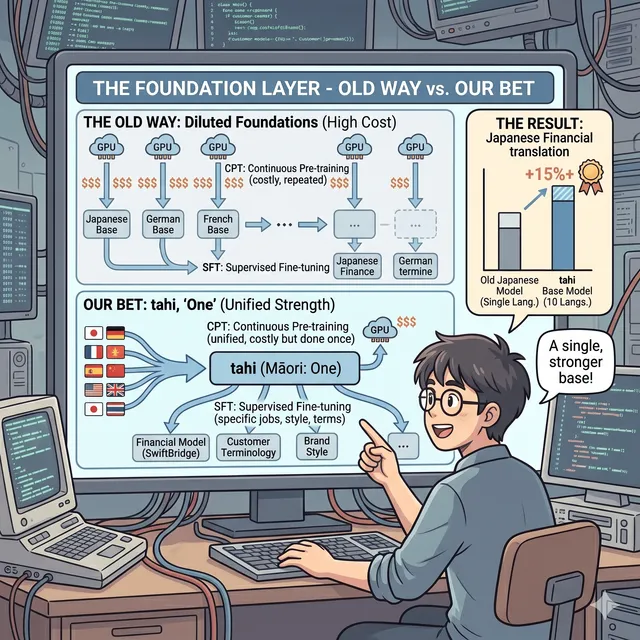
There's an obvious way to make a model better at Japanese: show it more Japanese. Want German next? Start again, with German. Each language gets its own model, its own training runs, its own time with GPUs. It's the intuitive approach, and historically (for most of the last decade) it was more or less ours too.
It's also the wrong one, or at least far more expensive than it needs to be. This year we finally measured how wrong, and the answer changed how we build every model.
Our bet
Earlier this year we stopped building one base model per language and trained a single one across ten. We call it tahi, "one" in Māori, because it's the first of the family and the thing every model after it stands on.
A quick word on how these models get built, because it matters. There are two stages. The first is pre-training (PT), or continuous pre-training (CPT): a long, expensive pass that teaches the base model the languages it will work in. The second is supervised fine-tuning (SFT): a shorter pass that teaches it a specific job, a domain like finance or manufacturing, a customer's terminology and brand style, and most importantly, how to follow instructions.
The first stage is a costly one. Done the usual way, you repeat it for every language pair and end up with a row of separate base models that share nothing with each other. tahi does it once instead, across all ten languages at the same time, trained on over a decade of real human translation rather than just scraped web text. Everything we build now sits on top of it: customer models, the financial model behind SwiftBridge, each one a specialisation of the same strong foundation.
The obvious worry is dilution. Spread your pre-training across ten languages instead of pouring it all into one, and surely each language comes out weaker than a model that did nothing else? That was the thing to test, so we built the single-language specialists too and put them head to head.
The result that made the case
We started with the hardest thing we do, Japanese financial translation. We already had a strong model for it, built the old way, on Japanese and nothing else. We fine-tuned tahi on the same dataset and put the two head to head.
We expected it to come close... Instead it won comfortably, scoring more than 15% higher across our quality metrics, all on a test set neither model had seen. The model that learned ten languages turned out to be better at Japanese than the model that only ever saw Japanese.
Why it works
Translation isn't ten separate skills. It's one skill, practised in ten languages.
How meaning survives a change of grammar. How tone and register carry across a sentence. How to render a number or a name or a date without inventing detail that was never in the source. Most of that is shared, so a model that learns it from German and Portuguese and French as well as Japanese learns it better, then brings all of it to bear when it translates Japanese. The high-resource pairs hold the low-resource ones up. In a real sense the other nine languages spent the whole training run quietly teaching the tenth.
This is the engineering side of something our CEO wrote on this blog, in Deep Knowledge Outweighs Wide Knowledge: depth beats breadth when the stakes are real. A model grounded deeply in translation and then taught a domain will beat a model that knows a little about everything and masters nothing. tahi is what "grounded deeply" looks like once you put numbers on it.
The fair fight
Japanese was the result we wanted. German was the one we needed, because German is where the foundational approach is supposed to come unstuck.
We had previously built one of our customers a specialist tiri model, exclusively for German. We pitched it against tahi, on the same datasets. If spreading the budget across ten languages costs anything, this is where it shows up. It didn't. tahi matched that specialist in both directions, landing inside the confidence intervals, which is the careful way of saying the two are indistinguishable.
That's the whole argument in one result. A model that split its pre-training across ten languages held its own against one built for German and nothing else, and beat the equivalent specialist on Japanese, all from the same base. The breadth came for free.
Half the size
Here's the detail worth pausing on. In both of those comparisons, tahi was less than half the size of the model across the table. The specialists were big, and each was built for a single language. tahi was the smaller model, trained for ten, and it still beat one and drew the other.
That's the part with teeth. Holding your own against a model twice your size, at the same quality, means you can serve something far smaller in production: a lot less memory, and the cost and latency savings that come with it. The foundation doesn't just save you a stack of training runs. It lets you ship something smaller, faster and cheaper, with better quality.
And it's worth being clear about why. Yup, a strong foundation gets you a long way, but a lot of the uplift comes down to how we train and the choices that turn that base into a finished model. That part is hard-won, it's specific to how we work, and it isn't something we'll lay out on a blog. The point isn't that one clever model pulled this off on its own. It's that a foundation built right, plus a training process we've spent years sharpening, is what lets a smaller model match a bigger one.
In closing
A foundation isn't the thing you show the customer. It's the thing everything else stands on.
So when a customer asks what their model is built from, the honest answer is over a decade of human translation across many languages, grounded long before it ever saw their data, then specialised to their brand, voice, and domain. The same base goes into every model we ship, and it gets stronger each time we add to it. Two more foundations are planned, Rua and Toru, two and three, taking the same idea further.
The question was never how to make a model fluent in more languages. It was how to make one that genuinely understands translation, and then teach it everything else.
Originally published on labs.straker.ai.