Contents5 sections
The Unsung Hero of AI: Why Your LLM Is Only as Good as Your Data Pipeline
Every AI team has the same story: a promising model, months of careful architecture work, and results that make you question everything you know about machine learning. The team scrambles to debug the training code, tweaks hyperparameters, and experiments with different optimizers. Then someone finally asks the uncomfortable question: "What if it's not the model?"
The hard truth is that your LLM is only as good as your data pipeline. While everyone's obsessing over the latest transformer architectures and parameter counts, the real competitive advantage is hiding in plain sight: the unglamorous, critical work of curating your data, via a robust data pipeline.
"Nothing could fix the building's flawed foundation." – Enter Shikai
In our work with Tiri Models, we've confirmed this time and again: the difference between a good model and an exceptional one is decided long before the first training epoch begins. It comes down to the nuanced, often tedious, work of data preparation.
The Three-Phase process
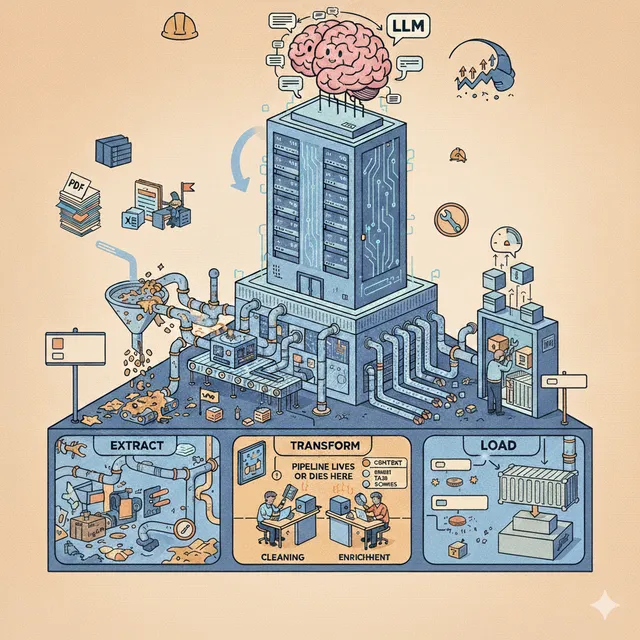
Every data pipeline that actually works in production follows the same fundamental pattern: Extract, Transform, Load. But here's what the textbooks don't tell you—each phase is a minefield of decisions that can make or break your model's performance.
Extract: Dive into your systems
The extraction phase sounds simple: grab data from wherever it lives. In practice, this is where you learn that "wherever it lives" includes a dozen different databases, a handful of PDFs, and even that one critical Excel file that someone from accounts updates manually every Friday.
Deciding which data to extract is a fundamental business decision that directly impacts your model’s effectiveness. Start by clarifying the model’s intended use case and identifying its end users—are they internal stakeholders or external customers? These choices shape not only what data you need, but also the privacy, compliance, and quality requirements you must meet. Importantly, the complexity of data extraction increases rapidly as the number and heterogeneity of data sources grow often in a nonlinear fashion. Integrating data from diverse formats, systems, and departments introduces challenges in consistency, access, and reliability that can quickly overwhelm even experienced teams.
Transform: Where Your Pipeline Lives or Dies
Here's where the main engineering happens. Raw data isn't just messy, it's messy in ways that can systematically bias your model.
The real challenge is that data quality issues are often invisible during training. A model will dutifully learn whatever patterns you feed it, whether those patterns are genuine signals or just artifacts from a messy dataset. This manifests when models produce technically correct outputs that feel wrong, often because the training data had subtle but systematic biases that weren't obvious during collection. The consequences only surface during evaluation, when data issues manifest as inconsistent outputs or complete failure to perform on specific domains.
The transformation phase is where you either build a robust foundation or unknowingly sabotage your model's future performance. Every transformation decision becomes part of your model's learned behavior:
Cleaning isn't just about fixing errors - it's about preserving signal while removing noise. When you strip HTML tags, you're deciding what constitutes "content." When you normalize date formats, you're choosing what consistency matters for learning. These aren't just data prep steps they can also be architectural decisions.
True Deduplication requires nuance - near-duplicates can teach valuable variations, while true duplicates create learning bias. Smart deduplication uses semantic similarity scoring rather than exact matching, recognizing that slight variations often contain important signal about real-world usage patterns.
Enrichment is where you add intelligence - this is your opportunity to inject context that dramatically improves model performance. Adding domain tags, formality markers, temporal indicators, or quality scores doesn't just provide more data; it teaches the model to understand its training context it could never learn from raw text alone. Take time and plan your enrichment accordingly.
Load: The Deceptively Simple Final Mile
The loading phase is straightforward on paper: take your expertly transformed data and put it somewhere your training pipeline can access it. In reality, this is where you learn that "format compatibility" can be a headache, and your "storage strategy" determines whether your pipeline scales smoothly or becomes a bottleneck.
Your data loading decisions will ripple through your entire lifecycle. Choose JSONL for easy human inspection but slower parsing. Go with Parquet for speed but lose the ability to quickly debug data issues. Store everything in a data lake for flexibility, or use HuggingFace Hub for convenience - each choice has downstream consequences, but you need to assess and pick what is right for you, and your volume of data.
What Makes a Great LLM Data Pipeline?
The difference between a pipeline that works in your Jupyter notebook and one that powers a production LLM isn't just scale, it's engineering philosophy. Here's what separates pipelines that actually work when it matters from those that crumble under real-world pressure.
It Fails Gracefully (Because It Will Fail)
Accept this truth: your pipeline will fail. The question is whether it fails catastrophically or recovers intelligently. Six-hour data processing jobs can crash at hour five because of a single malformed record.
A production pipeline assumes failure and plans for it. Smart checkpointing, automatic retries with exponential backoff, and the ability to resume from partial progress aren't nice-to-haves—they're essential. Well-designed pipelines survive API rate limits, network partitions, and those inevitable database maintenance windows that always seem to happen at the worst possible time.
It Scales Without Your Constant Attention
The scalability test isn't whether your pipeline can handle more data, it's instead whether it can handle more data without needing more of your time. This lesson becomes clear when datasets grow from thousands to millions of records. The pipeline that worked fine for small datasets becomes a full-time babysitting job at scale.
True scalability means your pipeline automatically consumes appropriate resources, or even distributes work across available compute, and handles pressure without manual intervention. If you're manually scaling your pipeline based on data volume, you possibly haven't built a pipeline, but rather a manual process.
Performance That Actually Matters
Speed isn't just about faster training, it's about faster iteration cycles and lower costs. When your data pipeline takes eight hours to run, you make different decisions about data quality and experimental changes. When it takes thirty minutes, you can afford to be more thorough and try more variations. This goes perfectly in hand with scaling.
Do not get caught up in optimizing for throughput, when you should optimize for total time-to-value. A pipeline that processes 10x faster but fails 50% of the time is slower than a reliable pipeline that just works.
Data Quality You Can Measure
"Trust but verify" is a excellent saying, but production systems need "measure and alert." Models that work perfectly in testing can have subtle quality issues in production. The problem? The data pipeline gradually degrades data quality over time, but without instrumentation, these issues go unnoticed until it's too late.
A feedback loop is vital: The most successful AI strategies treat data preparation not as a one-off task, but as a continuous cycle: Model Performance → Data Analysis → Pipeline Refinement → Retraining. This is how you find and fix issues that only become apparent at scale. Your data pipeline sits at the heart of this, so it’s critical to instrument it.
A Key Architectural Choice: ETL vs. ELT
When designing your pipeline, you'll encounter two main architectural patterns: ETL and ELT. The difference is when you perform the transform step.
ETL (Extract, Transform, Load): The traditional approach. You extract data, transform it, and then load the clean, final result into your destination. ELT (Extract, Load, Transform): The modern cloud approach. You extract raw data, load it immediately into a powerful cloud data warehouse, and then transform it using the warehouse's immense power.
Which is right for you? Well that's something you probably need to discover on your own. Do you have lots of infrastructure and good security? If so ETL is probably best. Do you rely on cloud providers and prefer their cloud data storage services? Well then ELT might be best.
Key Engineering Takeaways
Here are the hard-won lessons that separate successful AI initiatives from expensive experiments:
-
Version Control Everything: Use tools like Git to track changes to your pipeline code. Data pipeline code is still code, treat it with the same discipline as your application logic or SDLC.
-
Instrument Everything from Day One: You can't improve what you can't measure. Build observability into your pipeline architecture, not as an afterthought.
-
Test Your Transformations: Automate tests to ensure your data transformations are working as expected. Unit tests for data processing logic should prevent subtle bugs that can corrupt your training data.
-
ETL vs. ELT Isn't a Religious Choice: As mentioned above, it's an engineering decision based on your constraints. For massive datasets, ELT often wins because you're offloading that compute, and cloud warehouses are built for this workload... But if you're working with sensitive data, or have complex transformation logic, ETL is your better bet. Most of the data we deal with at Straker is sensitive, so we stick with ETL.
-
Automate or Die: Manual data curation doesn't scale past your first proof-of-concept. If you're manually fixing data quality issues, you're not building a pipeline, you're building a maintenance nightmare. Invest in automation early, even if it seems like overkill for your current dataset size.
-
Document Your Pipeline: Sounds simple, right? Write down how your pipeline works. Your future self, and team, will thank you when you're debugging a transformation three months from now.
-
Beware of Synthetic Data Shortcuts: While synthetic data can boost volume, it's a double-edged sword. Your model may just learn to replicate the specific quirks and systemic biases of the generation algorithm you used. If you use synthetic training data, it must be done selectively with quality checks that ensure you're adding signal, not just noise.
-
Stop Blaming the Model First: When a model underperforms, your data pipeline is probably the primary suspect. The most sophisticated architecture in the world can't overcome garbage data.
The Final Word
Here's what everyone building LLMs needs to understand: your competitive advantage isn't in having the latest architecture or the biggest compute budget, it's in having the best data, in a robust pipeline.
The teams that generate wins with AI aren't the ones with the most sophisticated models, they're the ones with the most sophisticated data engineering, and skills to use it. This is where innovation starts, and where lasting competitive advantages are built.
The pipeline is never finished, but that's the point. It's the structure that makes everything else possible, and makes your data great.
Originally published on labs.straker.ai.