Contents6 sections
IBM Think 2026: What We Took Away
I'm over a month (and a bit more!) removed from IBM Think 2026 in Boston now. The jet lag has cleared and I've had time to sit with the conversations and think about what was actually useful.
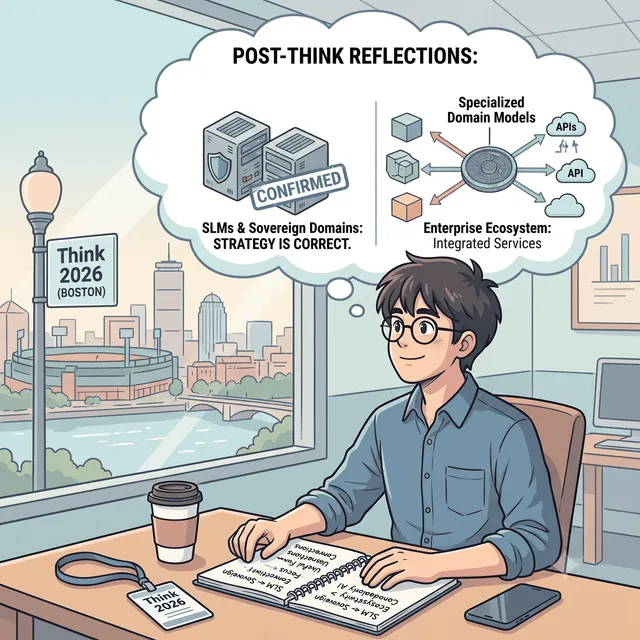
This isn't a recap of the keynotes, IBM does plenty of that themselves and that's not my style. What I want to share is what going to Think confirmed for myself, and Straker - specifically around where we're taking our SLM strategy, and what the broader ecosystem signals about the direction enterprise AI is heading.
The Shift Toward Purpose-Built Models
The conversation at Think, across sessions, hallway conversations, and the people building on the platform, reinforced something we've been believing for a while: the era of "one large model to do everything" is (or arguably, already has) giving way to something more nuanced.
What's emerging is a pattern closer to what we're already building: smaller, highly focused models that are very good at specific tasks, sitting inside orchestration frameworks that route the right request to the right model. This is the premise behind our SLM strategy, and it was good to see it reflected in where the industry is moving. Not just in marketing language, but in how teams actually talk about what they're building.
The analogy I kept coming back to is specialisation in any other discipline. A generalist can do many things adequately. A specialist does one thing exceptionally well. For most enterprise AI use cases, you don't need a model that can write poetry and explain quantum mechanics, you need a model that understands your domain, your data, and your required output format, and delivers that consistently. That's what we build, and I've written about that before on this blog.
The Platform Layer and What's Changing on watsonx
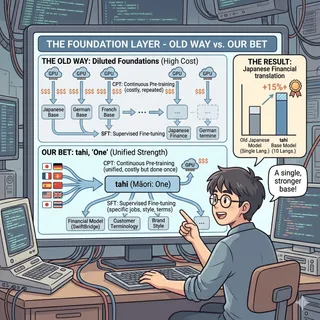
The Tiri family is purpose-built, trained on our own data, shaped around our use cases and our customers'. Watsonx is one of the platforms we deploy and serve them on. That matters, because what changes on the platform layer has real consequences for how and where our models run.
A significant part of our interest in Think was getting clarity on IBM's platform direction, specifically around which deployment architectures are going to be well-supported on watsonx going forward. The conversations were direct and useful, and left us confident that our roadmap and the platform's direction are aligned. I got to meet with many folks high up in the watsonx eco-system.
The broader direction IBM is signalling (small, data-indemnified, purpose-built for enterprise) is consistent with the standards we hold our own models to. That alignment matters less as a building block and more as a signal that the platform we're deploying on shares the same values around provenance, licensing, and transparency that our customers increasingly expect from us.
There's some other great things that came out with these conversations, but we're not ready to talk about that publicly yet. Watch this space.
Agent Orchestration: More Signal Than Hype
The agent conversation at Think was interesting because it's a space where there's a lot of noise right now. Everyone has an "agentic" story, and honestly, most of it is rubbish. What I found more useful was filtering for the teams, and companies actually dealing with the hard parts.
Our current architecture (https://getarbitr.straker.ai), hyper-focused agents governed by a conductor layer that infers the desired outcome and routes accordingly, maps closely to where the more serious conversations were. The key challenges that kept coming up weren't the exciting ones (which model should the agent use?) but the unglamorous ones: how do you make agent behaviour deterministic enough for production? How do you handle the failure cases? How do you maintain consistency when the orchestration is non-deterministic by nature?
These are problems we're actively working through. The Think conversations reinforced that we're asking the right questions, even if the answers are still being worked out.
On-device inference also came up: edge environments, remote operations, scenarios where you can't depend on a cloud connection. Not a use case we're solving for right now, but it's increasingly showing up on enterprise roadmaps. Worth watching.
What We're Taking Back to the Model Factory
The most concrete thing Think did for me was sharpen my thinking on the next six to twelve months of model development.
Our Model Factory, the brain that takes a model from data ingestion, to training, and through to deployment, is the infrastructure piece that makes our model building scalable. The goal is being able to train, evaluate, and deploy a hyper-focused SLM reliably and repeatedly, rather than treating each model as a bespoke project.
The platform direction confirmed we're heading the right way. The next generation of Tiri Models will deploy onto infrastructure with a clear forward path.
The Bigger Picture
Think 2026 landed at an interesting moment in enterprise AI (Talk about good timing by IBM). The hype cycle has started to mature, organisations that went all-in on large general-purpose models are confronting real questions about cost, consistency, and control.
It's now clear that teams doing the most interesting work are the ones who got past the basic "what model should we use?" questions and are now asking "what does this actually need to do, and what's the right architecture for that specific thing?"
It was good to be at a conference where the rest of the industry is catching up to it, and if I dare say it, us.
Originally published on labs.straker.ai.